Tuesday, August 21, 2012

Under the Spotlight


“Only man is a narcissistic enough species to think that a highly evolved alien life force would travel across billions and billions of light-years — a group of aliens so intelligent, so insouciant, so utterly above it all, they feel no need whatsoever to equip their spacecraft with windows so that they can gaze out on all that celestial beauty — but then immediately upon landing, their first impulse is to get in some hick’s ass with a flashlight.” ~ Dennis Miller

Monday, August 20, 2012

Pasiphae's Story

Pablo Picasso, Pasiphae
 
Through the tangled branches of an olive tree, she saw him white below her, turning his head from side to side in the breeze. She slid out of her crimson robe and threw it against the tangled branches, where it caught and hung. She prayed a moment to her sea-born sister, to Passageway and Cul-de-sac, then ran white over the grass, and threw herself down on her hands and knees before the god-engendered animal.
We have come to a Cul-de-sac in our narrative. Words, like politeness, provide us with a way of slipping a noose on the ideas, forces, and accidents, which are our lives and the life of the world. Physical access to metaphysical phenomena is forbidden mortals, but our obedient and observant servant, language, can reach out and touch - not, however, everything. I will not ask my words to lead us through the cypress branches, to overlook that turn of history. The sun-born had intercourse with the Queen, and she came again and again, every day through the warm summer, falling, we must suppose, among the yellow flowers, or among the little passageways his knife-sharp hooves cut in the grass of the gravelly bank.

Extract from: Pasiphae's Story, copyright © 1964 by Dirk van Nouhuys

Saturday, August 11, 2012

Minoan Bronze Age

Just too cute for words


The Armadillo Lizard possesses an uncommon and creative antipredator adaptation, in which it takes its tail in its mouth and rolls into a ball when frightened. In this shape it is protected from predators by the thick, squarish scales along its back and the spines on its tail.

Growing to an average length between 6 and 8 inches, it is certainly not a monster in the reptile world. But to some, it looks like a little dinosaur with skin that is covered with protective scales along its back and spines on the neck and tail. These physical traits make it extremely difficult and quite awkward for predators to attack it while it is curled up in it’s defensive position.

Most reptiles tend to be loners and not overly sociable creatures. But this is not the case for the Armadillo girdled lizard. In fact, you will often find a large group (sometimes up to 30 individuals) sharing the same rock crevice!  (read more at Save The Reptiles)


Minoan Sea Daffodils "Lilies" Fresco
Late Bronze Age (LBA), Late Minoan I Period
Akrotiri, Santorini (Thera), Greece.

Friday, August 10, 2012

Psyche's First Task: Systemizing


What is Systemizing


The brain looks for patterns for different reasons. First, patterns enable us to predict the future. If the church bell chimes exactly ten times every Sunday morning at exactly 10am, a mind that can systemize can then predict it will do so again this Sunday at exactly that time. Patterns in the church bells may not be a matter of life or death, but you can immediately see how such a general pattern-recognition system might have wide applicability - anything from predicting how prices vary in the market to how crops vary in different seasons.  Patterns also enable us to figure out how things work by suggesting experiments we can perform, to confirm predictions.  If I put a battery into my clock, the hands start to move.  That's a nice simple example, but that same ability to spot patterns can enable you to figure out a new device that has no instruction manual, or enable you to repair a device that has multiple components. In each case, the trick is to manipulate one of these componoents at a time, and see what happens - what pattern is produced.


The other valuable thing about patterns is that they enable us to  play with one variable at a time, to modify a system, thereby inventing a new one.  If you make a canoe thinner, it moves through water faster.  If you change the weight of an arrow, it can fly further, faster, and with greater accuracy. You can see that spoting such patterns is key to our ability to invent and improve.

Finally, spotting patterns provides us with direct access to the truth, since our predictions are either confirmed as true or false.  The church bell either does or does not ring as predicted.  Philosophers and theologians have long debated what we mean by truth.  My definition of truth is neither mystical, nor divine, nor is it obscured by unnecessary philosophical complexity. 


Truth is (pure and simply) repeatable, verifiable patterns.  Sometimes we call such patterns 'laws' or 'rules', but essentially they are just patterns.  Sometimes the truth might not be all that useful (e.g. the British postman uses red elastic bands to bundle the envelopes), and sometimes the truth might be very useful (e.g. an extra chromosome 21 will switch a baby to develop Down Syndrome).  Sometimes, the truth will reflect a natural pattern (e.g., left handedness is more common in boys than girls), and sometimes the truth will reflect a social pattern (e.g., in India you shake your head to show agreement).  But it is the repeatability of a pattern that elevates it to the status of truth.


Work cited, Zero Degrees of Empathy: a new theory of human cruelty by Simon Baron-Cohen, 2011

Thursday, August 9, 2012

Crone Humour


Queen Eleanor's window, St Hilarion Castle, Cyprus


An old lady, in order to save money, took the bus to visit the castle. On a-lighting at the bus stop at the summit of the pass, she exclaimed: "Why on earth didn't these Byzantine fellows build the wretched castle nearer to the bus stop? Just like them, they never think of the public."

Virtual Tourism - St Hilarion's Castle

The Law of Plaid Socks


Image sourced from Miss Magnolia Thunderpussy's Gallery


The Patagonia picnic table effect (also known as the Patagonia rest area effect or Patagonia rest stop effect) is a phenomenon associated with twitching in which an influx of birdwatchers following the discovery of a rare bird at a location results in the discovery of further rare birds at that location, and so on, with the end result being that the locality becomes well known for rare birds, even though in itself it may be little or no better than other similar localities. The name arises from the Patagonia Rest Stop in Arizona where the phenomenon was first noted.

Wednesday, August 8, 2012

Tying the Knot

Marrying the Hangman

by Margaret Atwood
 
 
She has been condemned to death by hanging. A man
may escape this death by becoming the hangman, a
woman by marrying the hangman. But at the present
time there is no hangman; thus there is no escape.
There is only a death, indefinitely postponed. This is
not fantasy, it is history.

*

To live in prison is to live without mirrors. To live
without mirrors is to live without the self. She is
living selflessly, she finds a hole in the stone wall and
on the other side of the wall, a voice. The voice
comes through darkness and has no face. This voice
becomes her mirror.

*

In order to avoid her death, her particular death, with
wrung neck and swollen tongue, she must marry the
hangman. But there is no hangman, first she must
create him, she must persuade this man at the end of
the voice, this voice she has never seen and which has
never seen her, this darkness, she must persuade him
to renounce his face, exchange it for the impersonal
mask of death, of official death which has eyes but
no mouth, this mask of a dark leper. She must
transform his hands so they will be willing to twist
the rope around throats that have been singled out
as hers was, throats other than hers. She must marry
the hangman or no one, but that is not so bad. Who
else is there to marry?

*

You wonder about her crime. She was condemned
to death for stealing clothes from her employer, from
the wife of her employer. She wished to make herself
more beautiful. This desire in servants was not legal.

*

She uses her voice like a hand, her voice reaches
through the wall, stroking and touching. What could
she possibly have said that would have convinced him?
He was not condemned to death, freedom awaited
him. What was the temptation, the one that worked?
Perhaps he wanted to live with a woman whose life
he had saved, who had seen down into the earth but
had nevertheless followed him back up to life. It was
his only chance to be a hero, to one person at least,
for if he became the hangman the others would
despise him. He was in prison for wounding another
man, on one finger of the right hand, with a sword.
This too is history.


My friends, who are both women, tell me their stories,
which cannot be believed and which are true. They
are horror stories and they have not happened to me,
they have not yet happened to me, they have
happened to me but we are detached, we watch our
unbelief with horror. Such things cannot happen to
us, it is afternoon and these things do not happen in
the afternoon. The trouble was, she said, I didn’t
have time to put my glasses on and without them I’m
blind as a bat, I couldn’t even see who it was. These
things happen and we sit at a table and tell stories
about them so we can finally believe. This is not
fantasy, it is history, there is more than one hangman
and because of this some of them are unemployed.

*

He said: the end of walls, the end of ropes, the opening
of doors, a field, the wind, a house, the sun, a table,
an apple.

She said: nipple, arms, lips, wine, belly, hair, bread,
thighs, eyes, eyes.

They both kept their promises.

*

The hangman is not such a bad fellow. Afterwards he
goes to the refrigerator and cleans up the leftovers,
though he does not wipe up what he accidentally
spills. He wants only the simple things: a chair,
someone to pull off his shoes, someone to watch him
while he talks, with admiration and fear, gratitude if
possible, someone in whom to plunge himself for rest
and renewal. These things can best be had by marrying
a woman who has been condemned to death by other
men for wishing to be beautiful. There is a wide
choice.

*

Everyone said he was a fool.
Everyone said she was a clever woman.
They used the word ensnare.

*

What did they say the first time they were alone
together in the same room? What did he say when
she had removed her veil and he could see that she
was not a voice but a body and therefore finite?
What did she say when she discovered that she had
left one locked room for another? They talked of
love, naturally, though that did not keep them
busy forever.

*

The fact is there are no stories I can tell my friends
that will make them feel better. History cannot be
erased, although we can soothe ourselves by
speculating about it. At that time there were no
female hangmen. Perhaps there have never been any,
and thus no man could save his life by marriage.
Though a woman could, according to the law.

*

He said: foot, boot, order, city, fist, roads, time,
knife.

She said: water, night, willow, rope hair, earth belly,
cave, meat, shroud, open, blood.

They both kept their promises.


The Other Carl Jung

York Gum Woodlands in the Charles Darwin Reserve

Carl Jung, (age 35/white) was hanged by the neck until dead at Mount Gambier, South Australia in November 1871, for the murder of Thomas Garraway, sheriff's officer.

Acting as an assistant bailiff of the Local Court of Mount Gambier, Garraway was sent to levy a distress warrant on the goods of Carl Jung, a German wine shopkeeper, residing near Blackwood Flat in the district known as the Hundred of Caroline.  Garraway and Jung had previously quarreled and on 29 June 1871, Thomas was bearing a writ to seize pigs and other property belonging to the debtor, Garraway exasperated Jung by taking what the latter considered was much more than was necessary to cover the debt.

When Garraway did not return to Mount Gambier, enquiries resulted in the discovery that when he had started on the return journey, driving away the seized goods in a cart, Jung toting a double-barrelled gun, had followed him. Upon overtaking the bailiff, Jung asked whether he would give back the pigs, saying that if he did not: he would shoot him.  Garraway refused and Jung discharged both barrels, killing him instantly and hiding the body in the bush at a place about three miles from Jung's residence, called the Deep Gully. 

Garraway's body was found on 2 July 1871 with gunshot wounds in his head and side. The marks of Jung's feet were also discovered.

Carl Jung who had taken refuge in an old hut, was arrested on 4 July 1871 by Trooper Fitzgerald, the "hero of the Gothenburg", who held a gold medal for his bravery in connection with the wreck of that vessel. 

Jung confessed to the slaying of Thomas Garraway in detail.  After Garraway had arrived at his house, Jung had asked him to wait until he had gathered enough money to pay the demanded sum of
nine pounds, but when Jung left the house, Garraway took away his horse, cart and two pigs.

Clearly Garraway was not blessed with negotiating skills and made the fatal mistake of believing that a piece of paper and a uniform rendered him immunity; from his own inability to recognise danger and earnestness.  In 19th century Australia, law enforcement was heavy-handed and corrupt individuals within that grafted British Empire model, did  live like parasites on the backs of honest and willing hard-workers.  They still do.

Jung was convicted of murder at the Mount Gambier Circuit Court on 20 October 1871, receiving the death sentence, and was hanged at Mount Gambier Gaol at 8am on 10 November 1871 by possibly the hardest working man in town, Benjamin Ellis.

Before Carl Jung was hanged he became thoroughly repentant, and in his confession stated: "I had no sooner shot Garraway than I thought all the trees cried out; 'murder.' "

In his ethereal and haunting movie, "Picnic at Hanging Rock", Peter Weir captured brilliantly this quality of the Australian landscape that sees everything, misses nothing and brings you face-to-face with the Jungian Shadow.  When you understand how lonely and sad this ancient landscape is; all the hurts and insults it has witnessed -  the injustices, the abuses of its native custodians and wholesale slaughter of it's flora and fauna - then you can go out into the bush and hear the songlines.


Sandplain shrublands, Charles Darwin Reserve

For the European settlers of the late 18th century, life in Australia was pretty isolated if you were living outside of the townships, as Carl Jung was.  His only company may have been his horse and two pigs - they may have been his family; his children.  Nobody deserves to be murdered in the carrying out of their official duties, yet the heartlessness of the authorities in those times is legendary and well-documented.  It would have taken a rare and empathetic human being to have seen the despair of Carl Jung's situation and been more moderate.  Thomas Gallaway did not have those qualities and seemingly demonstrated little regard for his own self-preservation.  No doubt his colleagues commended his 'noble death in the line of duty'.

At the end of the day, Thomas died because of  two pigs. He died because in his capacity as bailiff, he had made a threat on the ability of another human being to survive in the bewilderness.  There is no 'murder' here: just another sad footnote in the long history of the failure to communicate, that is a fearsome plague on our species.  We owe it to our ancestors and to the spirits within our landscapes, to walk our path with kindness, respect and generosity. To learn from their experiences and mitigate the consequences that our ill-conceived actions may give rise to, further down the wallaby track.


Further Reading

Beauty, Myth and Monolith: Picnic at Hanging Rock and the Vibration of Sacrality
The Mulga-Eucalypt Line: First postulated by the botanist von Mueller in 1883, the concept of the Mulga-Eucalypt line and its mapping has been refined by a succession of eminent geographers and botanists including Woodward, Diels, Clarke, Gardner, Burbidge and Beard, culminating in the currently accepted maps of the Biological Regions of Australia.

Images Gallawayed from Bush Heritage Australia

Tuesday, August 7, 2012

Walking to the Firing Line


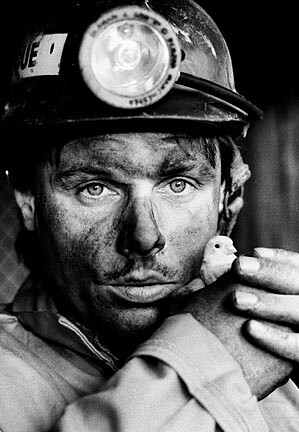
A coal miner with the last canary to be used down a coal mine in 1987

 
Nicholas Eberstadt, a demographer at the American Enterprise Institute who has written widely on Russia’s health crisis, told Orrin Judd in 2004. “They never get better. The country just keeps going down—in numbers, in health, and in its possibilities for the future. It seems to get worse every year, and I don’t see even the slightest suggestion that that is going to change. Russia, like Africa, I am very sorry to say, is taking a detour from the rest of humanity as far as progress is measured by improving general health.’’


You have to wonder why the Eramus group are creating new variants on pathogens and not using their expertise to find solutions for existing threats.....or perhaps H5N1 is a solution for a population whose innate immune responses have become impaired.

Preparing for the pandemic


In November 2011, a Dutch group  Erasmus MC in Rotterdam (led by Dr Ron Fouchier and read how he feels about being in the eye of the storm) succeeded in making a highly pathogenic variant of avian flu (H5N1) which, if released, could cause a global pandemic. Ever since, a storm has raged as scientists and governments worldwide attempt to deal with the findings and how they should be safely disseminated—if at all.

The team's work has sparked fears that the virus could be weaponized by being reassembled from the published data, amidst other concerns. The facility in which work on the virus was done is at biosafety level 3+ (BSL-3+). Critics argue this doesn't reflect the true threat accidental release poses, arguing that maximum-security BSL-4, which demands all lab workers wear positive pressure suits and be subjected to multiple decontamination steps, be the required standard for working with such a dangerous pathogen. (click to read the insanity)


In the eye of the storm. Flu researcher Ron Fouchier.
This surname Fouchier was derived from the Old German Fulchar a name meaning
the people-army.

First to fall over when the atmosphere is less than perfect
Your sensibilities are shaken by the slightest defect
You live you life like a canary in a coalmine
You get so dizzy even walking in a straight line
You say you want to spend the winter in Firenza

You're so afraid to catch a dose of influenza

~ Lyrics Canary in a Coalmine, The Police