Saturday, July 7, 2012

The Baader-Masada Phenomenon


The following is a tongue-in-cheek response given within a Forum to a member who is attempting to improve upon what nature endowed her with.  This comment is of the calibre of  Tolkein's clever Bilbo Bagginsism:  I don't know half of you half as well as I should like; and I like less than half of you half as well as you deserve. It is certainly a perspective to confound cognitive psychologists with and an brilliant example Mercury's word-trickery.


I suspect it is my Wilde self that gathers nutty sayings like this...or perhaps it is Just Me who enjoys clever turns of phrases and rapier-sharp wits. 


""We can say goodbye and then hello, or hello and then goodbye. Although some may find it difficult to say goodbye to the person they imagined you to be as this may question who they thought they might be. If they want to remain who they are, then they may feel who you now are, is not who you told them you were, and feel disapponted. Or they may feel who you were is not who they thought you were and are pleased another you is more like who they wanted you to be.

Some may try to talk you out of it for these reasons and others talk you more into it. Others may struggle to know who you now are and remain silent; unsure who the you is and not want to address the wrong one. Others may say this new you was to be expected in the circumstances.

The important thing is one of you decides if this is suitable. My 2 cents is that the before the new you you would need little encouragement so it may be a way of finding out how much this new you is you or not you, or a temporary you.

To shorten the reply I could have used u instead of you, like the youff today do, but felt the use of a u not a you may have been an inappropriate decision in relation to what has happened to you, or you or us.""


That's So Weird: Alan Bellows at damninteresting explaining the Baader-Meinhof phenomenon which I had never heard of before, yet look forward to hearing about a whole lot more.


Image:  one of King Herod's several private bathhouses in the ruins of Masada, showing the pillars which supported the floor. Outside a furnace would send hot air under the floor, creating steam. Middle of winter here in Australia: I sure could go a good steambath right now. 

Friday, July 6, 2012

As the Crow flies...


A group of crows has learned to recognise an apparently dangerous human, and to harass that person, simply because their neighbours and parents harassed them too. Learning from each other helps the crows respond to unfamiliar threats.[1]


Authoritarian Personality Type


This type of individual is characterized by three attitudinal and behavioral clusters which are interrelated.

1) Authoritarian submission - a high degree of submissiveness to the authorities who are perceived to be established and legitimate in the society in which one lives, or the peer group with whom one is involved or works. Naturally, if many of one's peers are personality disordered - and there is a high probability of that being the case in any field where authority over others is to be had - then one is inculcated into submissiveness to psychopathological ideation.


2) Authoritarian aggression - a general aggressiveness directed against other people that are perceived to be targets according to the established authorities as defined in number 1.


3) Conventionalism - a high degree of adherence to the traditions and social norms that are perceived to be endorsed by society - or one's peer group - and its established authorities, and a belief that others in one's society should also be required to adhere to these norms. Once again, if the traditions and social norms are established by authorities with control agendas, everything is corrupted from the top down.

According to psychologist, Robert Altemeyer, "authoritarians tend to exhibit cognitive errors and symptoms of faulty reasoning. Specifically, they are more likely to make incorrect inferences from evidence and to hold contradictory ideas that result from compartmentalized thinking. They are also more likely to uncritically accept insufficient evidence that supports their beliefs, and they are less likely to acknowledge their own limitations." (Robert Altemeyer, Right-Wing Authoritarianism, University of Manitoba Press, 1981.)[2]
 

Want Some More APTness?

The Myth that was Masada - Masada is increasingly being understood as part of that “modern dance of politics and archaeology.” Archaeologists understand they are interpreters, rather than just restorers of a pristine past. As a 1993 Learning Channel show on Masada stated, “Every archaeologist is in a sense a myth-maker, contributing by his discoveries to the creation of a shared, national story of the past.” [3]


Wal-Mart: 50 Years of Gutting America's Middle-Class - Sam Walton opened the first Walmart store in Rogers, Arkansas, 50 years ago this month. Sprawled along a major thoroughfare outside the city's downtown, that inaugural store embodied many of the hallmarks that have since come to define the Walmart way of doing business. Walton scoured the country for the cheapest merchandise and deftly exploited a loophole in federal law to pay his mostly female workforce less than minimum wage. [4]

Notilia

[1] Proceedings of the Royal Society B, DOI:10.1098/rspb.2011.057, published New Scientist, 2 July 2011, No2819

[2] Extracted from "The Golden Age, Psychopathy and the Sixth Extinction" essay written by
Laura Knight-Jadczyk and pubished at SOTT.net.

[3] The Myth that was Masada, observations of Jay Gary PhD, Foresight Coach, March 30 2002

[4] Wal-Mart: 50 Years of gutting America's middle-class, observations of Stacy Mitchell-Otherworlds, July 2 2012.
Image of a murder of crows flew over from Follow the Piper, a blog kept by an adorable and somewhat opinionated basenji in Kansas City.

Blinded by Athena


Pray God you can cope.
I stand outside this woman's work,
this woman's world.
Oh it's hard on the man now his part is over.
Now starts the craft of the father.

I should be crying but I just can't let it show.
Should be hoping but I can't stop thinking lf all the things
I should have done that I never did,
All the things I should have said but I never said.
Make it go away.

...Just make it go away.


~ "This Woman's Work" by Kate Bush, from Fish People


Image: Screen capture, blind priest, The Sentinel. The Horror Blogger of Horrordigest invites you to revisit The Sentinel synopsis and review.


.

Thursday, July 5, 2012

Hidden Teachings of Silver Birch


Silver Birch, as we call him, is not a Red Indian. Who he is, we do not know. We assume that
he uses the name of the spirit through whose astral body he expresses himself, it being impossible
for the high vibration of the spiritual realm to which he belongs to manifest except through
some other instrument. He is the spirit guide of what is known as "Hannen Swaffer's Home
Circle". ~ foreward by Hannen Swaffer, Teachings of Silver Birch, first published 1938.


In 1982, I attended a few services at the Victorian Spiritualists Union in A'Beckett Street, Melbourne, and purchased a little golden book entitled "Teachings of Silver Birch: Wisdom from the World Beyond".  Like Steve Beckow, I could say that Silver Birch was my earliest teacher in spirituality, although my first incursions into spirituality were really through the history articles and essays that were published in the women's magazine, English Women's Weekly, in the sixties and seventies. Such articles were not New Age woo-woo tainted and were gleaned and sourced from classic and authenticated historical and archeological records, to be presented to readers as hearty and solid fare for the imind, as a trencher of meat and potatoes is for the body.


Hannen Swaffer (1879-1961) was a British journalist and drama critic and in the 1930s was head of the spiritualist home circle that bore his name, and which followed the teachings of Silver Birch, the disembodied spirt who spoke through the channel of Maurice Barbanell for 61 years, until Barbanell's physical death in 1981.


Being no longer the impressionable child of the sixties, nor a seeker of the eighties; I still, nonetheless, have fondness for the Silver Birch whilst being able to discern the social, cultural and religious limitations of Maurice Barbanell.


It is my understanding that the teachings of  so-called "spirit guides" is constrained by, and strained through, the cultural biases, social prejudices and personal idiosyncracies of the medium. Maurice Barbanell was a man of his times, country and culture.  Hence the identification of Silver Birch as a "he" and not a "she".


With the rise of Adolf Hitler and Nazi Germany, it would not have been prudent for Silver Birch/Maurice to adopt a Norse/Germanic vernacular. In light of what we now know about Hitler's fascination with Germanic paganism, the historical emnity between Britain and Germany, it was more politic to allow people to assume that Silver Birch was a disincarnate spirit of vague Native American heritage. 


The Norwegian explorer and author Helge Ingstad began an intensive search for Norse sites in North America, beginning in New England and working his way northward along the coast. At L'Anse aux Meadows in Newfoundland, local residents were aware of mounds located in the peat bogs, but always assumed that they were Indian burial mounds. A local inhabitant, George Decker, led Ingstad to these mounds in 1960. For the next eight years, Ingstad, and his wife Anne Stine Ingstad led a team of international archaeologists in the excavation of the site. Rather than being an Indian burial ground, the mounds are the remains of a Norse community dating from approximately the year 1000. Further excavations by Parks Canada in the 1970s makes the conclusion incontrovertible. [1]


A.W. Austen, who edited many of the Silver Birch books, wrote: The appeal of Silver Birch is to Reason, and if anything he says is not acceptable to the reader's reason then it should be rejected or at least left as an open question pending further evidence.  The remarks of Silver Birch, and his replies to questions, are printed throughout in the more common type known as Roman.

Known as Roman.

The Rev. William Stainton Moses (1839-1892) was an English clergyman and Spiritualist. Born in Donnington, Lincoln, he would become a founding member of the London Spiritualist Alliance in 1884 (afterwards the College of Psychic Studies).  Moses is regarded as the man who gave Spiritualism its "bible" (sound familiar?) was one of the most remarkable mediums of the last century. There were twenty-two spirit communicators, headed by one who signed himself "Imperator".

British spiritualism of the late 19th and early-20th centuries is heavily infested with Christian references, for the British psyche has, for the most part, been guided and impressed upon by the doctrines and dogma of the Anglican and Catholic traditions; with a brief detour into Quakerism/Puritanism around the 17th Century.  Reaching further back the time-line, there are the traditions that the Roman legions brought, the Druidic, the Norse, Celtic, Calvanism, Presbyterianism and dozens of others.  The hedonist pursuits of British Royalty over the centuries should not be discounted either as having formed a particular idolatry amongst the commonfolk which endures to the present day. 


Long Live the Queen and Long She has Reigned.  While the Members of the Houses of Parliament now hold the reins, it could be said that the prominent members of the House of Windsor serve the function of cultural icon, of meeting a need for an idealized archetype of Mother/Father personifed by Kings and Queens: a vestigal relic from times long past. 


Rather like the presence of the frequently discarded appendix within the body.  Many doctors believe the appendix is a vestigial organ with no function and is no more than a blind ended tube connected to the cecum, from which it develops embryologically. Researchers in the United States say the appendix produces and protects good germs for the gut by "rebooting" the digestive system.


The team of immunologists at Duke University Medical Center say the human digestive system contains massive amounts of bacteria most of which are good and help the digestion of food.


However the researchers say sometimes the bacteria die off or are purged from the intestines as in diseases such as cholera or dysentery.


According to the researchers, the appendix's job is to "reboot" the digestive system when that happens with the bacteria safely harbored in the appendix.[2]


So what is the common thread between Spiritualism, British Royalty and a little purse-like organ in the human body?   Allow me to introduce you to an individual who embodied a guiding light for my journey through all things codswallopy, malarkish and fallacious: Erik the Dead.


Erik Weisz aka "Harry Houdini" who in the 1920s turned his energies toward debunking self-proclaimed psychics and mediums,  a pursuit that would inspire and be followed by later-day conjurers.  Houdini's training in magic allowed him to expose frauds who had successfully fooled many scientists and academics. He was a member of a Scientific American committee that offered a cash prize to any medium who could successfully demonstrate supernatural abilities. The prize was never collected.

Harry Houdini died of peritonitis, secondary to a ruptured appendix on October 31, 1926. [3]


Erik Weisz was my greatest teacher in healing. 

His simple message:

The bodily pain you ignore, WILL kill you.


Silver Birch: Lady of the Woods 


The silver birch is a distinctive and easily recognisable tree with it’s ‘silver’ white papery bark and pale-green leaves. It’s not a slow-growing monster of a tree but a fairly fast-growing and not so long lived slender tree.

One of the earliest trees to come into Britain after the ice age. It needs light but can survive in quite poor soil. Being one of the earliest members of our native woodland it has a lot of fungi associated with it.

Silver birches produce male and female catkins with the female catkins turning into ‘fruit’. Though not in the human enjoying “juicy” sense. Winged seeds are shed from September.

This is very much a tree associated with the feminine and female divinity (Culpepper called it a tree of ‘Venus’). Birch is the ‘Lady of the Woods’.

It has a reputation of being a poor timber and fit only for items such as brooms (for which it is very popular) but, in fact, it is almost as tough as ash. The bark was also used to make boats in Russia and for writing in early times. It’s charcoal was used for gunpowder.

Rather appropriately it was used to make bobbins and reels for the Lancashire textile industry - this craft being very much associated with the goddesses. The sap can be used to make a lovely wine, a sweet white wine. It was popular in eastern europe but a few breweries make it in Britain. Green birch poles were used to stir molten copper to ensure a purer copper was made (and copper is associated with the female divine in some cultures). Birchwood is popular in Scotland for domestic items such as flooring or furniture.

It is not only associated with fertility and love but protection (against the evil eye). It was also a symbol of punishment (being birched). Medicinally the sap and tar (?) were said to be good: the sap against kidney stones and the tar to help with skin ailments.

One Russian tale about a Birch tree in the island of Buian says that the Mother of God could be seen seated on top. Another tale has a shepherdess spinning in a birch wood and a wild woman came and made her dance for three days then rewarded with a load of birch leaves which turned into gold coins.

One old and supposedly christian tradition involving birch, in some parts of England, is that branches and sprigs were used to adorn churches at Pentecost. This is a christian feast near Easter and the young branches were supposed to represent ‘new life’. Which sounds about as christian as bringing greenery inside at Yuletide.

The birch crops up in some place-names in England. From the Old English beorc comes some names such as Barkham in Sussex or Berkeley in Gloucestershire and Somerset. It also turns up as birche in Birchanger in Essex or Bircholt in Kent. Up north some placenames contain the Scandinavian Birk such as Birkenhead.[4]


Birch is fruitless and bears shoots without seed,
but its branches spread high and beautiful
and are laden with leaves,
filling the sky

~The Rune Poem - Verse XVIII


Notilia

[1]  The L'Anse aux Meadows site was most probably a ship repair station, and a waypoint on the voyage to Vínland. The site contains the remains of three Norse longhouses used to house the ships crews.

[2] Gleaned from 'What Does the Appendix Do? Finally an answer!", News-Medical, Oct 8 2007

[3] Harry Houdini biography, Wikipedia.

[4] Trees in Northern Tradition: Their Botany & Place in Folklore - Wain 17, Vanic Ve


Image "Feathers and Tinctures" by Tracy J. Butler. Swiped from Witch of Forest Grove
Image: "Handcuff" Harry Houdini, circa 1905, purloined from Wikipedia.


Tuesday, July 3, 2012

Fruit of Goodly Trees: Recognition and Response:

In his thought-provoking book, Zero Degrees of Empathy: A New Theory of Human Cruelty, Simon Baron-Cohen makes a salient point:


Empathy is our ability to identify what someone else is thinking or feeling, and to respond to their thoughts and feelings with an appropriate emotion. There are at least two stages in empathy: recognition and response. Both are needed, since if you have the former without the latter you haven't empathised at all.

This 'if you have the former without the latter' brings to mind the tradition of Sukkot from Judaic mysticism and the inner meaning of the Four Species.  It reminds me that my own journey sprung from the backbone of Judaism when I was a child in the Sixties, and not the wishbone of the Human Potential Movement.


In was in  2004 that I came in through the bathroom window to Judaic mysticism whilst  researching an essay I wrote about lemons, entitled "The Goodly Tree".  On a warm Spring day I had been relaxing on a sunlounge under a lemon tree, enjoying the citrus scent and thinking about how much I love lemon trees.  How a lemon tree in the backyard is as iconic to an Australian as the Hills Hoist washing-line. How this humble little tree is taken for granted. How happy yellow lemons are.  How when I was in primary school, I was assigned to the sports house of Wills, whose house colour was yellow and how the colour yellow was considered a garish colour back then.


Yet the colour for the House of Wills wasn't flat lemon-yellow.  It was deep yellow-gold.  Changing the hue makes all the difference.  At East Reservoir PS we had four houses: Mitchell, Sturt, Burke and Wills. Named after famous explorers of Australia except I can't recall being taught about these explorers at all.  A significant oversight in the curriculum for certain.

When Harry Potter became a phenomenon, I missed the parallel between the sport houses of muggle East Reservoir PS and those of magical Hogwarts' : Hufflepuff, Ravenclaw, Slytherin and Gryffindor that supposedly correspond to the Four Elements of earth, air, water and fire respectively.

Or do they?


The Four Species (Arbah haMinim)

The Arbah haMinim, or the Four Species, is a ritual object used during synagogue services for the festival of Sukkot. Four specific types of trees are arranged together in a special way.

It is ordained in Leviticus 23:40: “On the first day (of Sukkot) you shall take the product of hadar (goodly) trees, branches of palm trees, boughs of leafy trees, and willows of the brook, and you shall rejoice before the Lord your God seven days.”


The four species as mentioned above are collectively called the lulav (palm) as it is the largest of the species.


The “fruit of goodly trees” has been interpreted to mean the etrog (citron). “Branches of palm trees” are the lulav; “boughs of leafy trees” refers to the myrtle; and “willows of the brook” are the aravot or hoshanot.

The four species allude to the four-letter name of God. The four are held together to signify the Unity of God.


Each species has a particular reference to God, according to a Midrash in Leviticus Rabbah, 83: the etrog is symbolic of Psalm 104:1: “You are clothed in glory and majesty”; the palm is used because it is said Psalms 92:13: “The righteous bloom like date-palm”; the myrtle signifies Zechariah 1:8: “And he stood among the myrtle-trees”; the willow is significant because it is written in Psalms 68:5: “Extol Him who rides on the clouds (aravot), the Lord is His name.”

The lulav implies the symbolism behind taste and smell. While the etrog has taste and smell, the lulav has taste but no smell. The myrtle has smell but no taste, and the willow has neither. Therefore the lulav is a depiction of every type of man: each being different, as a community they stand together.


Each of the four species signifies a limb of the body: the etrog refers to the heart; the lulav the upright backbone; the myrtle symbolizes the eyes, and the willow the lips. Each of the limbs is a means through which man serves God.

The lulav, whose central pillar is referred to as its "backbone" (shidrah) resembles
the backbone of man.
The leaves of the myrtle branch (hadas) resemble the eyes of man.
The leaves of the willow branch (aravah) resemble the lips of man.
The etrog resembles the heart of man.
There is also a masculine-feminine theme inherent in the four species. The lulav represents masculinity, whilst the etrog is seen as feminine, in its form. As symbols of divinity, they must be perfect in every way; therefore, the branches are chosen with care.
The cluster stays together with a special holder made from the leaves of a lulav. The two willow branches are placed to the left of the lulav, the three myrtle branches to the right. The etrog remains separate.

The four species celebrate the diversity of man and the many different forms of God’s presence.


Image: Sukkot-to-me, Arab Spring 2011
Image: Bee on Viper's Bugloss, attorlade one of the Nine Herbs of Odin. In Australia Viper's Bugloss is often confused to Paterson's Curse, to which it bears a resemblance. Both plants can be toxic to grazing animals.


Bad Banksia Woman


Yesterday I went walking along a trail I have never walked before, along a section of the five kilometre walking track within the Seaford Foreshore Reserve, which runs parallel to the beach through coastal dune vegetation from Keast Park to Mile Bridge.


I had travelled two morning train-stops from Bonbeach to Seaford, meandered my way through the small village of shops.  Engaging in genial and informative conversation with shopkeepers; the content of dialogue which alerts a seering person to recognise that this is a special day.  To release all notions of doing what I planned to do and to be as a thread in the Loom; to allow the Weaver to place me in the pattern.


Come in, come in, my dear.
It is lovely to have you here.
I see that you came in the back way.
Most people do 'though the best way
is to follow your dream
and come up the beam
from the smiling moon.


It had been a long time since I had stopped at Seaford - over a year, maybe two - yet the Hermit's spirit called, 'Come visit me' and so I did.  Back in the days, Capt. John Maddox was known as the Seaford Hermit.  The story goes he was captain of a ship that wrecked, killing many passengers and that Capt. Maddox retreated to a hermit's life within the ti-tree bush of Seaford foreshore. He built a camp decorated with shells, driftwood and the jetsam of people and frowned on blasphemers. He bartered for food and other items the tide didn't bring to him naturally. It was also said that a wealthy brother from Wales, came to Australia to persuade John to return to Swansea with him.


Some weeks ago, I tracked Capt. Maddox; learned that he was born 1846 in Fishguard, Pembroke, Wales.  I found an obituary placed by those that cared for this man who died so far from home.


The Argus, Monday 26 November 1917
FRANKSTON HERMIT'S DEATH.


FRANKSTON, Friday: - At the Homoeopathic Hospital, St Kilda road, yesterday morning, there passed away an eccentric man, John Maddox, who for 20 years has haunted the seashore. For eight years he occupied a primitive cabin near the beach at Elwood where he was well known amongst the yachtsmen.

He nexted camped on the Government reserve between the Nepean Road and the sea, about two miles out of Frankston. It is over 12 years since he first came to Frankston, and during that time his camp has been inspected by thousands of visitors. During his residence in Frankston he refused all monetary assistance.

Every day at 9 a.m and 4 p.m he used to call the birds, and hundreds of birds of all sort would fly around him, while he fed them. Maddox has left no relatives here but he is supposed to have a sister somewhere in Wales. He was receiving the old-age pension for some little time before his death, and the public are to be asked to contribute towards his funeral expenses. Donations may be sent to Mr. Mark Brody, Frankston.


As a child in the Sixties, my father would often take me to Elwood Beach in the middle of Winter. There is a photo of me,  dressed warmly, standing up to my knees in the water, holding my thick-itchy-fabric dress up so it wouldn't get wet. The day is Melbourne cloudy-grey with a chance of depression.   I remember that itchy-fabric felt icky-sticky against my skin when it got wet, so I was careful to keep it dry.  Such a fastidious child was I. 


My father was a pure-blood Englishman, an immigrant who came to Australia in 1945. He wouldn't have known about Capt. John Maddox - my father didn't know the Australian stories.  My mother, a native-born white Australian from bad-blood, hoarded whatever stories she might have known about the culture that existed beyond her self-inseminating laments.


It is not known whether Capt. John Maddox married or fathered children.  Perhaps he was one of those men whose vital spark is reabsorbed by the body and conveys no life to ovum.  Such men can embody the archetype of the Father.  Having no child of their flesh, they are free to enter the Wise Old Man, that aspect of Father that is sacred.  Timeless. Enduring.  Merlinesque.


Most do not, choosing Casanovian carnality.


The spirit of Capt Maddox dwells evermore in the ti-trees of the Seaford Foreshore, which is one of the oldest reserves in the Frankston area. The foreshore was set aside for public use in 1873 and re-reserved in 1987 for the purposes of conservation and recreation. In 1909 a small pier with a large pipe was built to pump seawater into Kananook Creek to flush through the polluted waters. The pipe was dismantled in 1953 but the pier still remains, a relic of times gone by.


Yesterday I had planned to walk along the Seaford pier, not minding the brisk wind and the cold sea air.  I will have to return to do so for the ingress to the pier was closed off by construction works, and had been since April.  A large flock of cormorants sat like barnacles at the end of the wooden projection and not presently disturbed by humans, they are for the time, the sole fisherfolk of Seaford Pier.


The daughter of my neighbour passed me then and as she did not expect to see me there; she did not see me at all.  So I had to call her name - see me now - and we chatted some moments, during which she told me she regularly walks along the beach from Seaford to Chelsea because she "needs it".


I thought "Yes, I need a long walk too", yet not along the sandy beach.  My juno desired to walk along the track in the midst of the greenery, where I have not walked before.  I set off not knowing where the track would come back out into concrete surburbia, only that the direction in which I was heading was homeward bound.


Only very resilient grasses such as Hairy Spinifex and Blue Tussock-grass survive on the coastal fore dunes, which are exposed to the wind and salt spray. Their roots help bind the fragile dunes together, enabling other plants like Coast Tea-Tree, White Correa and Coast Daisy-Bush to survive. On the secondary dunes closer to the road we find a delightful Banksia Woodland dominated by Coast Banksia and Coast Beard Heath. [1]


It was through the Banksia Woodland that I walked and within fifty steps I had passed through the veil and the spirits knowing what I am, sent another to come alongside me.  Alas  this Woodland in modern times, is a known haunt for flashers and perverts who display their goods, hoping to receive services from unwary females.  Such an encounter is an unpleasant shock to younger women; to a female of my age, very little is surprising.  My usual defence is to comment "With such a small member, I am surprised you like to show it off!  That is nothing to be proud of!". 


I possess a ready wit with an emasculating tongue that only fools entice me to draw from it's scabbard of seeming feminine helplessness.  Men who lurk in secluded places do not expect to encounter females who are skilled in martial arts, so I walk in such places with the knowledge that I have abilities that can destroy the groin.


However, yesterday, the man who joined me was a Seaford local, undertaking the daily walking of his two gambolling joyful canines, which that looked as though a Dingo was their great-grandmother. As is custom amongst Melbourne folk, he commented negatively on the weather.  To which I replied, "It's a beautiful day for clearing out the cobwebs and can you tell me where this path will take me?"


We didn't exchange names yet  spoke of places we had lived, of things done, people loved, and about future journeys in the chartmaking.  He crowed that in a month's time he would leave Seaford to start a new life in a place south of where I had once lived.  A place that, of late, I have been journeying back to in my dreaming, tracing the topography of my past and diving through the landscape of my psyche. Remembering to unremember; storying to unstory; dreaming to dream anew. My juno-bird flying north to find warmth.


So - no great surprise to me to meet a man who flashed me with a glimpse of the Wise Woman, the archetype of Maiden-Mother-Crone, that I am becoming to embody, and regalia-ed me with stories from the North.the


In such ordinary ways, the Sacred Consort arrives to guide, protect and natter the way with a  female Seid who has walked alone along a deep green track some fourteen years.  Tempus fugit.


As a southern seid I recognise when a daimon oversouls a human man  - something in the eyes, the rhythm of speech, the absence of flirtatious inroads. The daimon knew that I knew the human man sort of knew his path. Was uprooting his life to search through illusion for that greener grass that is always in all ways right under your toes. I knew that the daimon knew that it was really I who came alongside this human man, to convey to him, things he would need to know about the community he was about to live within.  I detected in the man the same romantic idealism I once held of small-country town folks and a mythology of conviviality that reality tore asunder. The man's speech  bubbled with Neptune's hope and as I walked alongside his reality distortion field, I felt that I was watching over his sleep-walk.  The man told me he had two adult daughters, both Primary School teachers and I kept silence on the sharp observation I had made in 2008; that psychology will never be an endangered profession with Primary School teachers elephant-and-star stamping unworthiness and not-good-enoughness into the children-of-women.


In 2008, I was placed as a Teacher's Aide within a Frankston Primary School under the auspices of a now defunct Work For The Dole scheme, which is another term for community service, that service which individuals convicted and charged of criminal misdemeanours are forced to undertake. The parallel resonance was not lost on me.  It was educational for me to seer where, how and why human children are spoiled within the institution of learning.


I knew from the response the man gave to information I conveyed about my own circumstances, that he lived within a bubble of narcissistic parameters; that his understanding of other was walled with assumptions, that people take refuge behind when they can't imagine the difference.


Through the lightness of a Banksia Woodland, I walked alongside a rather dense man.  I am learning to know the difference between mirror, mask and man.


For over thirty years I have served the One who sent me.
I arrive wherever I am called to weave together the threads for another.
When I depart, I find myself further untangled from the cloth of confused men.


Images

1. Capt John Maddox c. 1909
2. The Hermit's Folly, Seaford Foreshore, Victoria, c. 1909
3. Bad Banksia Women, pen & ink drawing by Kay Craig, 2000.  More of Kay Craig's delightful botanical art can be viewed at Passionate Observers.
4.  Banksia Woodland is found on flat to gently undulating, sandy soils in near-coastal regions of southern and eastern Victoria. The altitude range is generally between 10 and 100 m above sea level and the rainfall varies from 700 to 1000 mm a year. About 65% of the area once supporting Banksia Woodland in Victoria falls on public land while about 40% is represented in conservation parks and reserves. About 25-30% of all Banksia Woodland has been permanently cleared for agriculture or urban development. There are two basic forms of Banksia Woodland one which is strictly coastal (Coast Banksia Woodland - CBW) and one which is near-coastal (NCBW) but occurs up to 30 km inland. In East Gippsland the two forms often grade into each other. Read more at Viridans - Victorian Ecosystems.


Notilia

[1] Extract from 2nd Edition Natural Reserves within Frankston City, published Jan 2010.

Monday, July 2, 2012

Man's Naked Ambition


Excerpt from Breaking The Spell: Religion as a Natural Phenomenon, Daniel C. Dennett, Penguin Books, 2006 [p 176-177]


Here is a well-known trajectory: You begin with a heartfelt desire to help other people and the conviction, however well or ill founded, that your guide or club or church is the coalition that can best serve to improve the welfare of others.  If times are particularly tough, this conditional stewardship - I'm doing what's good for the guild because that will be good for everybody - may be displaced by the narrower concern for the integrity of the guild itself, and for good reason: if you believe that the institution in question is the best path to goodness, the goal of preserving it for future projects, still unimagined, can be the most rational higher goal you can define.  It is a short step from this to losing track of or even forgetting the larger purpose and devoting yourself singlemindedly to furthering the interests of the institution, at whatever costs. A conditional or instrumental allegiance can thus become indistinguishable in practice from a commitment to something "good in itself." A further short step perverts this parochial summum bonum to the more selfish goal of doing whatever it takes to keep yourself at the helm of the institution ("Who better than I to lead us to triumph over over adversaries?")


The Buoyant Force


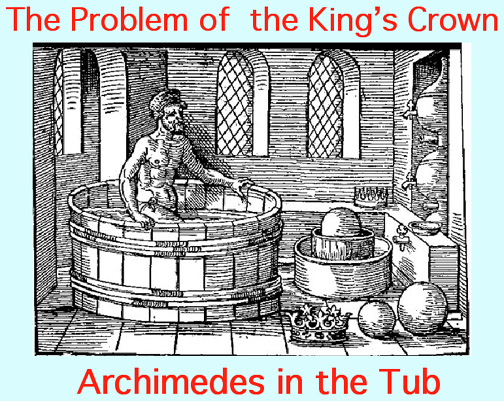
So King Hiero of Syracuse ordered his goldsmith to make him a new crown. The gold was weighed out and given to the goldsmith.  When the goldsmith presented the king with the finished crown, the crown was weighed. The weight matched the original weight of the gold.


However, King Hiero suspected that the crown was not pure gold, so he asked Archimedes to figure out how to test it. The story goes that when Archimedes lowered himself into his bath, the tub overflowed and this inspired him to discover the solution to the crown problem.


With much excitement, Archimedes leapt from the tub, omitting his toga, and streated down the street to the palace crying, "Eureka!  Eureka!"


Thus was discovered Archimedes' Principle: an immersed body is buoyed up by a force equal to the weight of the displaced fluid.


To test the crown, Archimedes weighed it in air and again when suspended under water. The loss of weight in water is called Buoyant Force and is the weight of the displaced water.


For example: If the crown weighs 1000 grams in air and 900 grams under water, the buoyant force is 100 grams. Because the density of water is 1.0g/cm3, cm3 can be substituted for grams to get the volume of the crown.

Density = mass/volume, so this density is 1000g/100 cm3 or 10 g/cm3. This is a long way from 19 g/cm3, the density of gold!


It seems the goldsmith alloyed the gold with a cheaper metal and kept the extra gold for himself. So just what is the difference in the alloyed crown such that it has the correct weight? 


The size. 


The alloyed crown must be larger: and so the oft-quoted quip that has never been attributed to Archimedes was also discovered:  Size Matters!


Image: Northern Territorian Mike Foley streaking career began in 1974 when he released his song The International Streaker.  In 2009, after a streak in Ireland, he hoped to put his streaking to a good cause, raising money for charity with producing calenders.  In February 2012 Mike - now 72 - has streaked at iconic spots in more than 20 countries and was on a streaking holiday in New Zealand.  He most recently streaked on a skateboard at sunrise in front of Mount Maunganui on Wednesday. His wife Kay takes the photos and he sells a charity calendar of his antics for Variety*NT each year.


Variety : the children's charity


Sunday, July 1, 2012

Sometimes The Magic Doesn't Work


The beauty of the trees,
the softness of the air,
the fragrance of the grass,
speaks to me.
And my heart soars.
~ Chief Dan George


I remember a movie from years ago called Little Big Man that featured Dustin Hoffman and an American Indian actor, Chief Dan George, who had a wonderful role as the shaman, Old Lodge Skins.  In this film, the Cheyenne were beset by troubles from the white man, and the shaman determined that some sort of big magic had to be done to fix the situation, to rectify the laws of nature and protect the Cheyenne. He decided that he would take himself and his assistant, Dustin Hoffman, up to some holy mountain - a long, arduous trip - and then perform some big magic on top of the mountain, and the inevitable result was that the status quo would be restored. So, they climbed up this big mountain and performed these elaborate rites, invoked the ancestors and all the proper spirits. They waited for the results, and there were no results. So, finally, he just turned to Dustin Hoffman and said: "Sometimes the magic doesn't work." [1]


Robert Zoller's memory tricksied him. The plot of the movie goes this way:

Jack aka Little Big Man (Dustin Hoffman) soon becomes a trapper and hermit.  His mind becomes unhinged after coming across an empty trap with a severed animal limb. Poised at the edge of a cliff, he prepares to commit suicide.  Jack suddenly hears the faint chords of the traditional cavalry tune "Garryowen" echoing through a valley and spots Custer and his troops marching nearby. Jack decides to exact revenge.


Custer, who remembers that Jack once tried to assassinate him, hires him as a scout, reasoning that anything Jack says will be a lie, thus serving as a perfect reverse barometer. Jack leads the troops into a trap at the Little Bighorn.  Before the attack, Jack truthfully tells Custer of the overwhelming force of Native Americans hidden within the valley of the Little Bighorn. Custer does not believe him and leads the 7th Cavalry to its doom.


During the frantic battle, Custer begins to rave insanely. Ignoring the closing circle of warriors, Custer points his pistol at Jack. Before he can pull the trigger, Custer is killed by Younger Bear, who removes the unconscious, wounded Jack from the battle by carrying him to Old Lodge Skins' tepee. Having thus discharged his life debt, Younger Bear tells Jack that, the next time they meet, he can kill him without becoming an evil person.


Jack accompanies Old Lodge Skins to a nearby hill where the aged, weary leader decides to end his life. He offers his spirit to the Great Spirit, and lies down to wait for death. Instead, it begins to rain. Old Lodge Skins sighs and says, "Sometimes the magic works, and sometimes it doesn't".


They return to his tepee to have dinner. [2]


Who really killed Custer?  I ain't telling, yet theories abound and stories continue to be told.

Notilia


[1] Excerpt from an Interview with Robert Zoller, principal of the Academy of Medieval and Predictive Astrology, which can be read in full at  Skyscript

[2] Excerpted from Wikipedia's entry on Little Big Man - movie.


Image Chief Dan George (July 24, 1899 - Sept 23, 1981) was a chief of the Tsleil-Waututh  Nation, a Coast Salish  band located on Burrard Inlet in  North Vancouver, British Columbia, Canada. He was also an author, poet, and an Academy Award-nominated actor. In 1960, when he was already 60 years old, he landed his first acting job.

Lay of the Nine Herbs


From the Anglo-saxon Lacnunga as quoted in Ealanour Sinclair Rhode, The Old English Herbals, pub Minerva 1922 and 1974. In the Lacnunga [1] we are told which these nine herbs are. They are mugwort, waybroad (which these modern people call plantain), stime (watercress), atterlothe, maythen (camomile), wergulu (nettle), crab-apple, chervil and fennel.

The Nine Wort Charm of Woden [2]


A worm came creeping,
he tore asunder a man.
Then took Woden
nine magic twigs,
then smote the serpent
that he in nine bits dispersed.


Now these nine herbs have power
against nine magic outcasts,
against nine venoms
and against nine flying things
and have might against the loathed things
that over land rove.


Against the red venom, against the runlan venom,
against the white venom, against the blue venom,
against the green venom, against the dusky venom,
against the brown venom, against the purple venom.


Against the worm blast, against the water blast,
against the thorn blast, against the thistle blast,
Against the ice blast, against the venom blast.


If any venom come flying from the east,
or any come from the north,
or any come from the south,
or any come from the west,
over mankind.


I alone know a running river
and the nine serpents behold it.
All weeds must now to herbs give way.
Seas dissolve and all salt water
when I this venom from thee blow.[3]


Notilia

[1] The Lacnunga ('Remedies') is a collection of miscellaneous Anglo-Saxon medical texts and prayers, written mainly in  Old English and Latin.

[2] Nine Herb Charm of Woden expanded.

[3] Lacnunga Charms: circa 1050 - Hullwebs History of Hull

Painting Loke och Sigyn (1863) - by Swedish artis Mårten Eskil Winge

Photograph by arctangent : Topaz Spring millrace, Douglas Co. Missouri with watercress growing where the water is diverted to the North Fork of the White River. The water swirls where it makes a right angle turn to exit the millrace, and this creates a quiet pocket for the watercress to grow in.